
10 New Build Myths Your Clients Will Raise, and How to Answer Them
Share this post
Since the May Budget, the conversation with investor clients has changed shape.
From 1 July 2027, negative gearing on established residential property gets quarantined, losses can only be offset against other residential property income or capital gains, not against salary and wages. New builds keep full access, and anything held before 7:30pm on 12 May 2026 is grandfathered.
For the client we see most often, with a $600k to $800k budget and relying on negative gearing to cover holding costs, that reshapes the shortlist. And it isn't a 2027 problem. CBA, NAB, ANZ, Macquarie and ING have already removed or capped the negative gearing add back in servicing for established purchases contracted after Budget night, so your client's borrowing capacity on that stock is being cut now, not in eighteen months.
Rates have added to the pressure. The RBA lifted the cash rate to 4.60% on 29 September, its fourth rise this year and the highest level since 2011, and signalled it could go further. Higher repayments squeeze servicing on every purchase, and the negative gearing add back is now one of the few offsets left. It's only available on new builds.
More of these conversations are landing on new builds, and that's where the objections start. Some are outdated, some are true of the market but not of a well selected package, and a couple are fair. Here's how we'd answer each.
Myth 1: "New builds are bad for cashflow"
This comes from comparing a new build to a renovated established property at the same price, which isn't the real comparison.
Three things drive the gap. Depreciation: since the 2017 rule change, investors can't claim depreciation on second hand plant and equipment, so an established buyer inherits a building where much of that benefit is used up and can't be restarted. A new build claims capital works at 2.5% for 40 years plus the full plant and equipment schedule from day one. Maintenance: near zero in the early years. Rent: new stock generally achieves a premium and leases faster. Then layer 2027 on top: the new build keeps the ability to offset a rental loss against salary, and the established property doesn't.
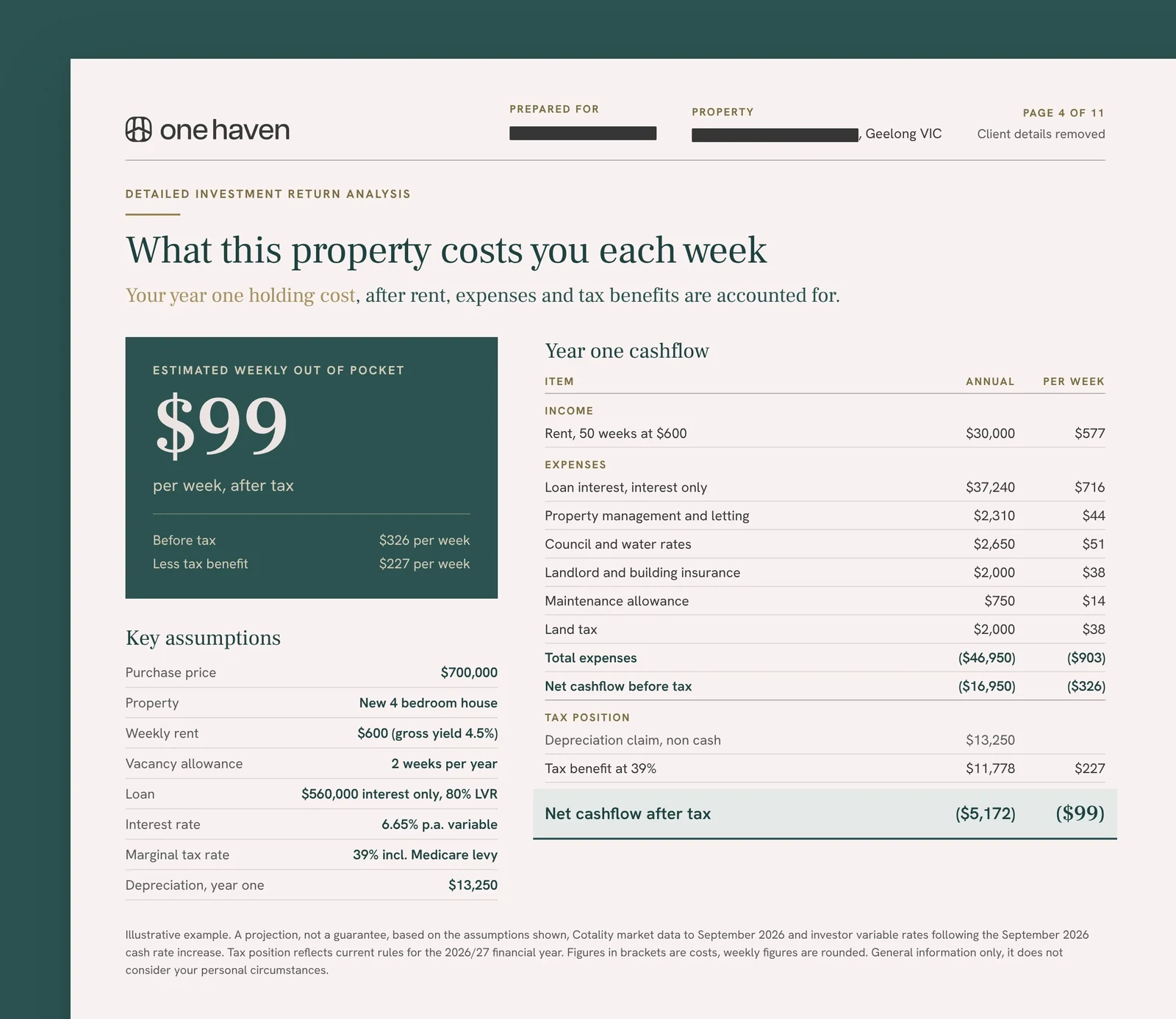
The better answer, though, is to stop arguing and run the numbers. Every client gets a property investment analysis report as part of our consultation: a projection of the weekly out of pocket position on the specific property, using their marginal tax rate, depreciation schedule, expected rent and loan structure. The weekly figure depends on rent, loan structure and their tax rate. In the example below, a new four bedroom house in Geelong for a client on the 37% tax bracket, it comes to $99 a week after tax. Not a claim, a projection they can test against their own budget. If you've got a client stuck here, we'll prepare the report and you can walk them through it together.
Myth 2: "Build quality is poor"
The standard has moved. New houses and townhouses in adopting jurisdictions must now meet a 7 star NatHERS equivalent thermal standard, up from the 6 star minimum that stood for over a decade, which shows up in tenant utility bills and in how the property presents against older stock.
We also don't take builders on trust. Our builder and developer partners are assessed on delivery quality before we place a client with them: completed project inspections, defect history, warranty claim record, references. The quality lottery a client faces picking a builder off a website isn't the risk they're taking with us.
And there's recourse. Statutory warranties override anything written into a building contract, and home warranty insurance is mandatory above a set contract value in most states and territories. In Victoria, that cover extends to major defects, including structural defects, for up to six years after completion. An established property carries no warranty at all.
Myth 3: "The property still needs work before it can be rented out"
True of plenty of new builds, which is why the objection exists. A "builder's finish" contract can hand over a house with no floor coverings, no blinds, bare dirt out the front and no fencing. Not ours. One Haven properties are turnkey, with floor coverings, blinds, landscaping, driveway, fencing, letterbox, clothesline and appliances included, and hand straight to the letting agent.
The proof isn't the inclusions list, it's our client base: many of our clients buy interstate and never set foot in the property. If someone can settle two states away and have a tenant in place without visiting, "needs work before it's rentable" isn't describing this product.
Compare a $650k established purchase, where a kitchen, carpets or a bathroom in year one is close to certain, funded out of pocket, and capital works rather than an immediate deduction.

Myth 4: "Build times are too long"
Fair, and worth being straight about: on the latest ABS figures (2024/25), average completion times sit at roughly 11.5 months for houses, closer to 15 for townhouses.
But two things get misunderstood about what that costs. Funds are drawn progressively and interest is only payable on what's drawn, so the holding cost in the early months is a fraction of what people assume. With the cash rate at 4.60%, that difference is worth more than it was a year ago. And the comparison isn't twelve months against zero. An established property needing work before letting has its own dead period, funded at full loan interest from settlement day.
Myth 5: "You lose money the day you settle"
The toughest objection on the list, and one to take seriously rather than wave away. The counter isn't that no price gap ever exists. It's that the comparison ignores what the established buyer pays to get in: stamp duty on the full value, building and pest, remediation in year one.
Run the after tax position across the hold rather than the entry price alone and it looks different. We'll model both sides for any property your client is weighing up. Under the new law, new builds also keep an option at sale: the 50% CGT discount, or indexation with the new 30% minimum tax. That's a choice established stock has lost.
Myth 6: "Off the plan is risky, the builder could go under"
The sector data is confronting and we won't pretend otherwise. ASIC data shows 3,435 construction companies entered external administration in 2025/26, around a quarter of all company insolvencies and more than any other sector. That was the first annual fall in five years, but August was a reminder of how quickly it can turn: a single developer group collapse put 540 construction companies into administration on one day. Which is exactly the argument against choosing a builder on price off a website.
Our partners are assessed for financial viability, not just product quality, before a client is placed with them. On top of that sits process: fixed price contracts, the warranty insurance certificate sighted before construction starts, staged payments released against visibly completed stages rather than calendar dates, and independent inspection at frame stage, lock up stage and completion.
None of that makes a builder failure impossible. It's the difference between a risk assessed and managed, and one your client carries alone.

Myth 7: "The valuation will come in short at settlement"
We rarely see this, and the reason is pricing discipline rather than luck. We price land and build packages against comparable sales in the same area over the preceding twelve months, so the valuation basis is tested before the client signs. That's a different proposition to an off the plan apartment valued two years after contract, which is where most of the horror stories come from, and it's the short answer to Myth 5.
The part worth your attention: construction lending draws progressively, valuation happens at completion, and the finance needs to be right at the front end rather than sorted out at handover. That matters more with values easing through winter. The valuation reflects the market at completion, not at contract, so it's worth structuring the finance with some buffer rather than assuming the contract price.
Myth 8: "New builds don't grow like established homes"
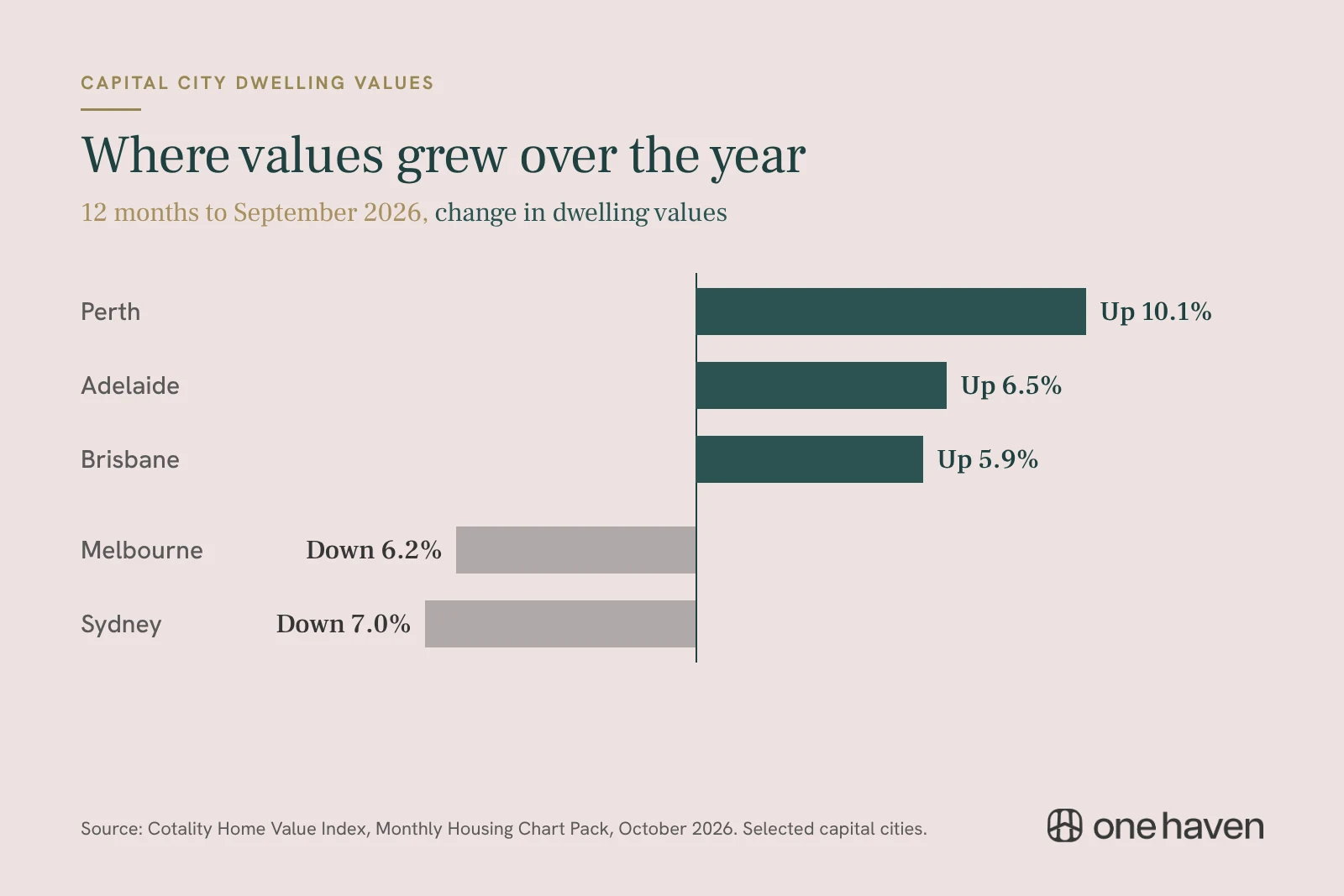
Growth attaches to land and location, not the age of the dwelling, and a house and land package in a supply constrained corridor carries land content just as an established house does. The markets where new supply is being delivered are still among the strongest over the year. In the 12 months to September, Perth was up 10.1%, Adelaide 6.5% and Brisbane 5.9%, while Sydney fell 7.0% and Melbourne 6.2%.
The short term has turned, and it's worth saying so. National values have now fallen for six straight months, higher rates are weighing on buyers, and Perth, Brisbane and Adelaide have each eased from their autumn peaks as listings rise. Darwin was the only capital to rise over the September quarter. None of that changes the answer below, but it does mean growth is a long term case, not a short term one.
For us, location selection comes before product selection. The real answer isn't "new builds grow", it's that we don't buy where we don't expect growth.
Myth 9: "It'll be hard to rent, tenants don't pay more for new"
Rental markets have loosened a little. Cotality's national vacancy measure rose to 1.9% in August, its highest since January 2025, and Sydney is now above 2%. But the markets where new supply is going in remain tight, Adelaide the tightest at 1.3%, and advertised rents are still rising. New stock also lets faster, holds tenants longer and, with the 7 star standard in force, costs less to run. As vacancy edges up, that advantage counts for more. Lower vacancy is a cashflow input clients often overlook when they compare properties on rent alone.
Myth 10: "The rules will just change again, this is a tax fad"
The most sophisticated version of the objection, and the fairest. The core reform is already law and the carve outs do most of the work: existing owners grandfathered, new builds carved out entirely, nothing taking effect until 1 July 2027. The detail is still settling, mostly in investors' favour. Treasury's second tranche of draft legislation, which closed for consultation on 21 August, would treat a dwelling as new if it's bought within 24 months of the occupancy certificate, up from 12 months in the Budget. That part isn't law yet.
But the underlying point deserves a straight answer. A property should stand up on location, rent and demand first, with tax as the tiebreaker rather than the reason. If a deal only works because of the tax position, it isn't one we'd put in front of your client either.
The Takeaway
The tax settings have moved in favour of new builds, but that's not the argument. Most objections describe the risks of buying badly, such as an unvetted builder, a builder's finish contract or a price untested against the local market. They aren't risks inherent to new property. Take those out and what's left is a well located, fully let, fully depreciable asset with warranty behind it.
If a client conversation stalls on any of these ten, talk to David Avery, National Partnerships Manager. We’ll run the numbers on your client’s scenario together.
David Avery, National Partnerships Manager
General information only. It doesn't take account of any individual's objectives, financial situation or needs, and isn't tax advice. Clients should seek their own taxation advice before signing contracts. Out of pocket figures are illustrative projections for one example property, based on the assumptions shown, individual results will vary and projections are not a guarantee of future performance. Tax rules described are current at September 2026; some details, including the final definition of an eligible "new build", are in draft legislation and not yet law.
Sources: 2026/27 Federal Budget papers; Treasury Laws Amendment (Tax Reform No. 1) Act 2026 and Treasury exposure drafts (Tax Reform No. 3, tranche 2, August 2026); ATO guidance on Division 40/43 depreciation; National Construction Code 2022 (7 star NatHERS); ABS Building Activity (completion times 2024/25); ASIC insolvency statistics, 2025/26 and to August 2026; RBA monetary policy decision, 29 September 2026; lender broker updates from Macquarie, NAB, CBA, ANZ and ING, May to June 2026; Building and Plumbing Commission (Victoria) domestic building insurance guidance; Cotality (formerly CoreLogic) Home Value Index to September 2026, and rental vacancy data to August 2026.
Header image licensed under the Unsplash+ License
View more from the Haven Hub
Real stories from the people we’ve helped, sharing their experiences, outcomes, and the impact we’ve made along the way. These insights reflect our commitment to delivering results that genuinely matter to our clients.

The 2026 Federal Budget and Australian Property: What's Really Changed
The 2026 Federal Budget has permanently reset the maths of Australian property investment. Negative gearing on established stock is gone from 1 July 2027, but new house and land packages keep every benefit. Here's what changed, why it matters, and the $18,600-a-year gap now separating the two strategies.

Why you should invest in property
Apart from purchasing a property and seeing the uptick in value over time, there are additional financial incentives and benefits that – if you buy well – arise as part of the process of investing in property.

The value of patience in property investment
Like most successful investment strategies, time and patience are two key factors when it comes to achieving solid returns on the property market.

Key terms to understand before you start investing in property
When you first start thinking about investing in property, it can seem a bit daunting…but you shouldn’t let that get between you and your first investment!

Property investment 101: Your go to guide before getting started
Property investment 101 will demystify property investment for you! So before you get started buying, make sure you take a few minutes to finish reading!

Strong Finish to 2025 Sets the Stage for the Year Ahead
The Australian housing market wrapped up 2025 on a remarkably strong note, a trend that provides invaluable insight as you consider your investment moves for 2026.
No pressure
No jargon
Just clear advice and ongoing support from people who genuinely care.